
- You are here:
- Home »
- Blog »
- Driveways »
- Understanding Driveway Sealers and Specialty Pavement Coatings
Understanding Driveway Sealers and Specialty Pavement Coatings
Choosing a driveway sealer may seem simple until you begin comparing products. Some formulas prioritize fuel resistance, while others offer greater flexibility, lower odor, faster cleanup, or a particular finish.
Understanding the primary driveway sealer types can help you avoid applying an incompatible product or paying for protection that does not match your driveway’s condition.
Why Choosing the Right Driveway Sealer Matters
Asphalt contains a binder that holds the pavement’s aggregate together. Exposure to sunlight, rain, snow, automotive fluids, road salt, and normal traffic gradually weakens that binder. The surface may eventually fade, become brittle, develop cracks, or lose aggregate.
Sealing creates a protective barrier that slows this deterioration. However, sealcoating is preventive maintenance, not a structural repair. A driveway with potholes, severe settling, drainage problems, or interconnected alligator cracks may need more extensive work before it can be sealed.
Here are three types of pavement sealers and coatings, along with their common applications and important considerations.
1. Asphalt Emulsion Sealer
Why It Is a Popular Residential Choice
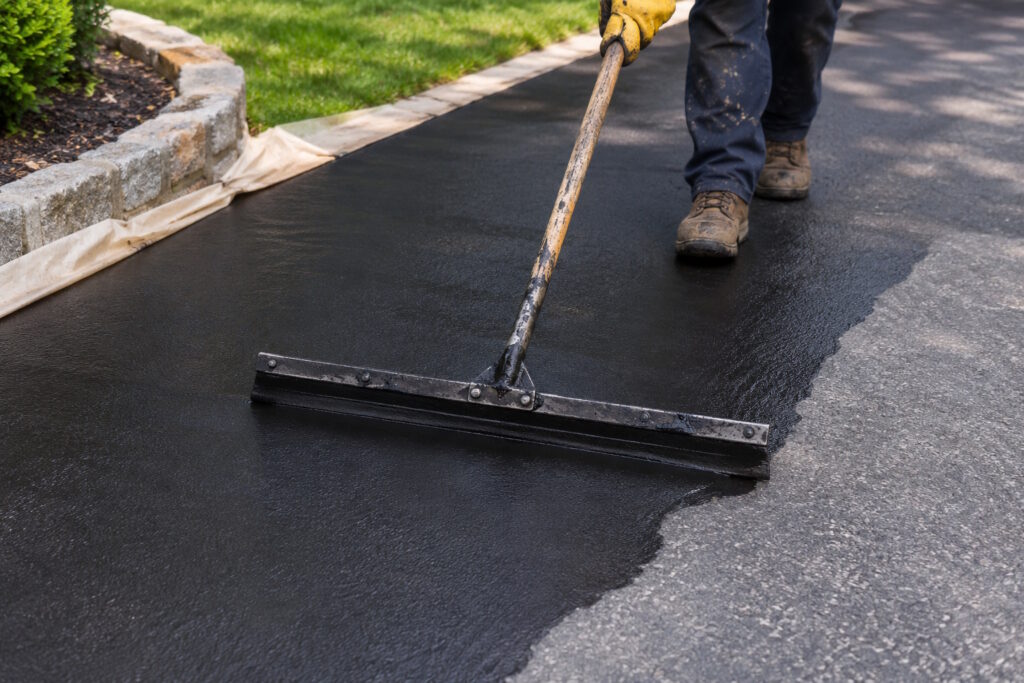
Asphalt emulsion sealer is made using asphalt, water, emulsifying agents, and performance-enhancing additives. It provides a durable protective coating with a rich, natural-looking black finish.
Asphalt emulsion sealer is a widely used option for residential asphalt driveways. When properly applied, it provides a protective coating that helps reduce the effects of moisture, sunlight, and everyday wear. At Palermo Paving, we use professional-grade asphalt emulsion sealer for our sealcoating services.
Limitations to Consider
Asphalt emulsion sealer can be affected by gasoline and oil spills, so leaks & oil spills should be cleaned promptly to prevent staining or deterioration.
The product also requires properly prepared pavement and favorable weather. Applying it shortly before rain or during unusually cold conditions can interfere with curing.
2. Acrylic Coatings for Specialty Surfaces
Where Acrylic Sealers Perform Best
Acrylic coatings are commonly used for specialty surfaces, including tennis courts, basketball courts, pickleball courts and certain decorative concrete applications. Depending on the formulation, they offer durability, weather resistance, and a variety of colors and finishes.
While Palermo Paving primarily uses asphalt emulsion for traditional driveway sealcoating, we also undertake specialty paving projects, including recreational courts.
Cost and Application Considerations
Acrylic sealers are usually more expensive than conventional asphalt sealcoating products. Surface compatibility is critical, so a product should never be selected based only on its appearance.
Glossy coatings can also become slippery when wet. Where traction is a concern, the product may require a slip-resistant additive.
3. Latex-Acrylic Sealer
Applications for Latex-Acrylic Coatings
Latex-acrylic coatings are polymer-based products used in certain specialty pavement and recreational surface applications. Depending on their formulation, they can provide flexibility, weather resistance, and a uniform finish.
These products are not necessarily interchangeable with conventional asphalt driveway sealers. Their suitability depends on the existing surface, intended use and manufacturer’s specifications.
When It May Not Be the Best Option
Quality varies considerably. A low-cost latex-acrylic product may wear prematurely under frequent traffic or turning tires.
Proper application matters as well. Multiple thin coats generally cure more evenly than one heavy coat, which may remain soft or develop an inconsistent finish.
How to Determine the Right Sealcoating Solution for Your Driveway
Evaluate the Driveway’s Present Condition
Begin by checking for fading, hairline cracks, loose stones, stains, depressions, potholes, and drainage problems. Minor cracks can often be repaired before sealing. Extensive deterioration may indicate that resurfacing or replacement would be a better investment.
Consider the Local Climate
For a Long Island driveway, flexibility and water resistance are particularly important. Moisture entering cracks can freeze, expand, and worsen pavement damage.
The project should also be scheduled during a dry stretch with suitable temperatures. Rain, sprinklers, overnight moisture, and premature vehicle traffic can all affect the finished coating.
Compare Performance, Appearance, and Cost
When considering driveway sealcoating, it’s important to look beyond the initial cost. The quality of the material, proper surface preparation, applications methods, and ongoing maintenance all influence long-term performance.
At Palermo Paving, we use professional grade asphalt emulsion sealer to help protect asphalt driveways from moisture, oxidation, and everyday wear while restoring their appearance.
Make Sure Sealcoating is Appropriate for Your Driveway
Asphalt, poured concrete, brick, and natural stone require different treatments. An asphalt sealcoat should not be applied to a concrete driveway, and a decorative masonry sealer may not perform correctly on asphalt.
The new material must also be compatible with any coating already on the surface.
Why Preparation and Application Matter as Much as the Product
Even the best driveway sealer types will fail when applied over dirt, vegetation, loose pavement, untreated oil stains, or active cracks.
Before application, the surface should be thoroughly cleaned and allowed to dry. Cracks and potholes should be repaired, and nearby garage floors, sidewalks, masonry, curbs, and landscaping should be protected.
Correct coating thickness is equally important. Applying too much product does not create better protection. It can cause slow curing, tracking, peeling, and an uneven appearance.
Improve More Than the Surface of Your Driveway
Sometimes sealcoating is all a driveway needs. In other situations, the property could benefit from drainage corrections, asphalt repairs, resurfacing, a new concrete apron, masonry borders, or complete driveway replacement.
In addition to asphalt paving and sealcoating, PALERMO PAVING, offers a wide range of services, including concrete work, drainage improvements, oil and stone driveways, masonry, patios, walkways, driveway aprons, and other hardscape improvements. Our team can evaluate your property’s needs and recommend appropriate solutions.
Looking at the entire hardscape allows us to recommend improvements that work together functionally and visually.
Contact PALERMO PAVING for a Driveway Evaluation and Quote
Determining whether sealcoating is appropriate depends on your driveway’s age, condition, previous coatings, drainage and traffic.
Let us help you determine whether your driveway needs sealcoating, repairs, resurfacing, replacement, or another hardscape improvement. Contact PALERMO PAVING today to request a quote.
About the Author PALERMO PAVING
PALERMO PAVING is a family-owned-and-operated Long Island paving company. As such, we have a vested interest in our work. This translates into your paving project being done correctly and professionally. We pride ourselves in our expertise in paving, as well as our dedication to honesty and treating all customers with the care they deserve.